Heardle 50s How to Play the 1950s Music Guessing Game
Heardle 50s is a music guessing game that challenges you to identify a 1950s song from a short audio clip. In the daily Heardle Decades edition, you have six attempts, with longer snippets helping you work toward the answer. It is a straightforward challenge: how quickly can you turn a familiar sound into the correct song title?
You can find the Heardle 1950s game here. The Heardle Decades website currently lists the 1950s edition among its decade-based games, although individual audio tracks may not work everywhere.
Whether you know the decade through family records, oldies radio, or your own playlists, the appeal is the same: that moment when a tiny musical clue suddenly becomes a song you recognise.
What Is Heardle 50s?
Heardle 50s applies the familiar “name that tune” idea to music associated with the 1950s. Instead of answering a written trivia question, you listen to the beginning of a recording and try to identify it.
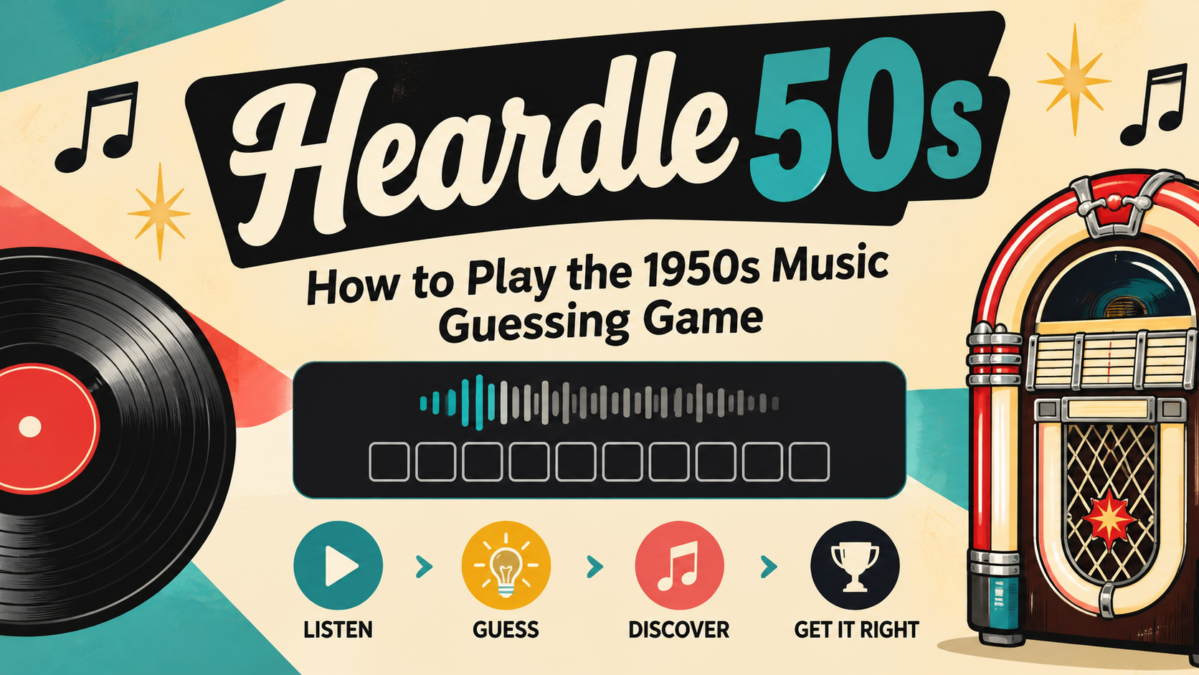
The daily format starts with a very short snippet. An incorrect answer or a skipped turn unlocks more audio, and the round ends when you solve it or exhaust your attempts. Playlin’s listing describes the Heardle Decades edition as beginning with one second of music and allowing six tries.
This makes recognition more important than knowing musical terminology. You do not need to read sheet music or name a chord progression. You need to connect what you hear with a title and artist.
However, remembering a chorus is different from recognising an intro. A song you could sing along to may still be difficult when the only clue is a brief instrumental opening.
Where Can You Play Heardle 50s?
Start with the Heardle Decades website and choose 1950s, or use the direct game link above. Its directory also includes other decades and artist-specific challenges.
Several unrelated websites use similar names, so check which edition you have opened before comparing answers or scores. A page labelled “Heardle 50s” does not necessarily use the same playlist as the Heardle Decades game.
The developer describes the Heardle Decades games as independent clones and says they are free to play, supported by advertising.
Is It the Original Spotify Heardle?
No. Spotify’s original Heardle closed on May 5, 2023. The continued existence of decade-themed games does not mean Spotify reopened that service. Heardle Decades is a separate project using the music-guessing format.
That distinction matters when following older tutorials. Instructions, saved statistics, and links for the original game may not apply to the edition you are playing now.
How to Play Heardle 50s
The basic process is easy to learn:
- Open the 1950s game and press the audio play button.
- Listen to the available clip before deciding on an answer.
- Type part of a title or artist’s name into the search field.
- Select the matching suggestion, then submit it.
- Skip if you are unsure, or use the extra audio revealed after a wrong answer.
- Continue within the six-attempt limit.
The developer specifically advises selecting an answer from the suggestion list because manually entered text can fail to match the required formatting.
For your first round, focus on understanding the controls. There is little benefit in rushing a guess before you have checked how the search suggestions and audio player behave.
Once the round ends, listen again with the answer in mind. The connection between the intro and the title is often much clearer after the reveal.
Why Can a Familiar Song Be So Difficult?
A short clip removes much of the context that normally helps you recognise music.
You may know the singer’s voice but hear only instruments. You may remember the chorus while the puzzle uses a quiet introduction. You may also know another recording of the same song, with a different tempo or arrangement.
Think of it like recognising a person from a silhouette. One clue can feel familiar without being specific enough to identify the answer.
This is why an early mistake does not necessarily mean you know little about the decade. Sometimes you simply need the voice, melody, or rhythm to develop.
Practical Tips for Better Guesses
These listening exercises can help you approach each round more deliberately.
Describe the Sound Before Naming the Song
Before entering an answer, form a short description of what you heard:
- A solo voice or several voices?
- A gentle introduction or an energetic one?
- A steady pulse or a freer opening?
- A prominent instrument or a dense arrangement?
The aim is to separate observation from assumption. “A bright, fast introduction” gives you something to test against the next clip. “It must be my favourite singer” may send you down the wrong path.
Hum the Melody Away From the Player
If a phrase sounds familiar, stop playback briefly and hum it.
Sometimes your memory supplies the next musical phrase when you are no longer concentrating on the screen. If that happens, follow the melody rather than immediately searching for a title.
You do not need to sing accurately. This is a private memory exercise, not a performance.
Change Your Theory After a Wrong Answer
A rejected guess gives you useful information. Avoid submitting several songs by the same artist merely because that artist was your first thought.
Ask what supported your guess. Was it a distinctive voice, or just a general mood? Then listen for evidence that could point elsewhere.
For example, if you guessed from the accompaniment alone, wait for the vocal entrance before committing to another singer.
Practise Introductions, Not Just Choruses
Build a small practice playlist from music you already enjoy. Listen to the first few seconds of each track without looking at its title, then check your answer.
Mix familiar favourites with songs you only partly know. You are training the exact connection the game tests: opening sound to song identity.
For a harder variation, ask someone else to choose the tracks so that playlist order does not become a clue.
Keep a Short Discovery List
After a missed puzzle, record the title, artist, and one memorable detail about the intro.
A useful note might be “voice enters immediately” or “recognisable melody starts after the accompaniment.” Keep these notes brief enough that you will actually revisit them.
This turns an unsuccessful round into something more lasting than a lost score.
Is Heardle 50s Daily or Unlimited?
The Heardle Decades 1950s edition is presented as a daily game. Other websites advertise separate unlimited versions, including a page on Heardle.info. Those versions should not be assumed to share the daily game’s song selection or results.
Choose a daily puzzle if you enjoy comparing one shared challenge with friends. An unlimited format may suit practice, provided the particular site offers functioning rounds.
Before comparing scores, agree on the exact website and puzzle date. Otherwise, two apparently identical challenges may involve different recordings.
What to Do When Heardle 50s Is Not Working
Begin with simple checks:
- Confirm that your device and browser tab are not muted.
- Check whether sound is being sent to disconnected headphones or another speaker.
- Press the player directly.
- Refresh the page if it appears stuck.
The developer also identifies regional audio restrictions as a possible cause of playback failure. A game page can load while its selected recording remains unavailable in your country.
Your Answer Does Not Appear
Try a more distinctive word from the title and inspect the suggestion list carefully. The official FAQ notes that suggestions can be hidden off-screen on mobile and recommends refreshing when expected entries are missing.
You Want to Move Your Scores
Heardle Decades provides a statistics transfer tool that lists the 50s game among its supported options. Follow its export and import instructions when moving to another device.
Conclusion
Heardle 50s offers a simple way to test your recognition of older music and discover songs you have overlooked. Start with the daily 1950s edition, listen carefully, and use each extra snippet to reconsider your answer. Try a round, then give the revealed song a full listen the discovery can be as enjoyable as the correct guess.